

9 Dirty Ways to Make Money Online in Nigeria (100% Legal)
Dirty ways to make money online in Nigeria — before your mind goes somewhere wild, let me stop you right there. This isn’t about fraud. It isn’t about Yahoo. And no, nobody is asking you to sell their soul on the dark web.
The word “dirty” here means something different.
It means unglamorous. Overlooked. The kind of work most people scroll past because it doesn’t look sexy on Instagram. The kind of hustle nobody brags about at hangouts because it sounds too basic, too boring, or too beneath them.
But here’s the twist — these “dirty” methods are the ones quietly funding the lifestyles of people you admire online. That guy posting from his MacBook at a café in Lekki? He might be doing number four on this list. That girl who just moved into her own apartment without a traditional 9-to-5? She might be knee-deep in number seven.
The irony is thick. People chase the shiny, popular online businesses — dropshipping, crypto trading, influencer life — and ignore the methods that actually pay. Consistently. Without needing 50,000 followers or a viral moment.
You want to know what works in Nigeria right now? Not in theory. Not in some motivational thread on X. Right now, in 2024 and heading into 2025, for someone with a phone, internet access, and a willingness to get their hands dirty?
Keep reading.
Why Most People Fail at Making Money Online in Nigeria
Let’s address the elephant in the room first.
Most Nigerians who try making money online quit within the first three months. Not because the opportunity isn’t real — it absolutely is. They quit because they were chasing the wrong thing.
They want the result without the process. They want to earn in dollars but don’t want to learn a single marketable skill. They sign up for platforms they don’t understand, watch two YouTube videos, try it for a week, and when the alert doesn’t hit, they conclude that “online money na scam.”
Sound familiar?
The truth nobody posts about is this: the people making consistent money online in Nigeria are doing things that look boring from the outside. They are not glamorous. They are not trending. But they work.
And that’s exactly what this list is about.
9 Dirty Ways to Make Money Online in Nigeria
These are 9 ways you may want to consider
1. Transcription Work (Yes, People Still Pay for This)
Transcription is one of the most underrated online gigs in Nigeria. The job is straightforward — you listen to audio or video recordings and type out what’s being said. That’s it.
No degree required. No portfolio. No pitch deck.
Platforms like Rev, GoTranscript, and TranscribeMe accept workers from Nigeria. The pay starts modestly — around $0.30 to $1.00 per audio minute — but experienced transcribers earn significantly more, especially in medical or legal transcription.
Why is this “dirty”? Nobody wants to sit down and type out a 45-minute interview recording. It’s tedious. It’s repetitive. Your fingers will ache. But the money is real.
Here’s a rough breakdown:
| Platform | Pay Per Audio Minute | Payout Method | Nigerian Access |
|---|---|---|---|
| Rev | $0.30 – $1.10 | PayPal | Yes |
| GoTranscript | $0.60 per minute (avg) | PayPal/Payoneer | Yes |
| TranscribeMe | $0.79 – $1.00+ | PayPal | Yes |
| Scribie | $0.05 – $0.25 | PayPal | Yes |
Start with general transcription. Build speed and accuracy. Then move into specialized niches where the pay jumps considerably.
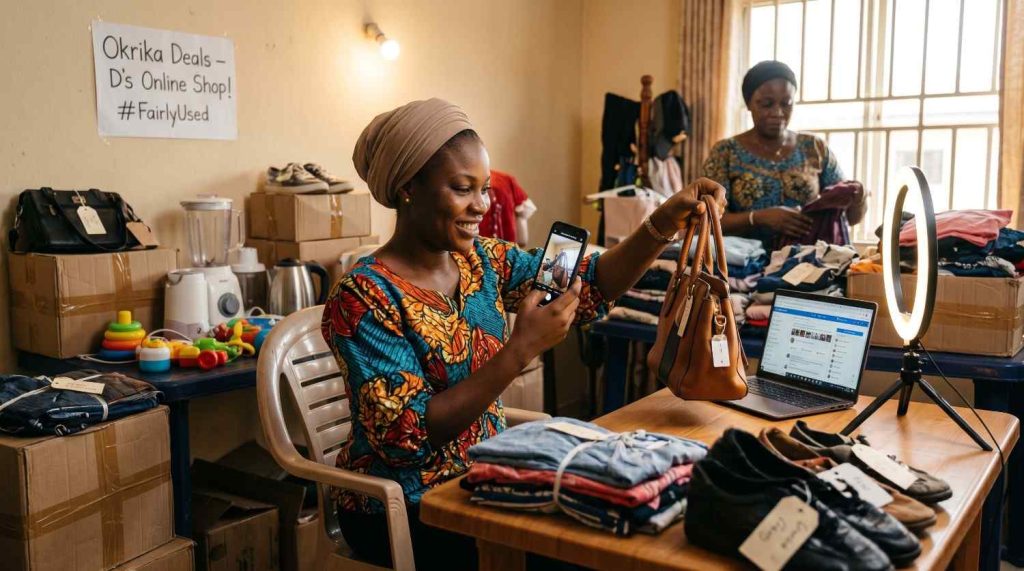
2. Selling Used Items Online (Flipping, Nigerian Style)
This one sounds almost too simple. But people in Lagos, Abuja, Port Harcourt, and even smaller cities are making a steady income doing this.
The concept is called flipping. You buy items cheaply — from markets, thrift stores (okrika), estate sales, or even people clearing out their homes — and resell them online at a markup.
Platforms to use:
- Jiji
- Facebook Marketplace
- WhatsApp Status (yes, seriously)
- Instagram shops
What sells well? Electronics, phones, furniture, sneakers, vintage clothing, and kitchen appliances. A blender you bought for ₦3,000 at a local market can sell for ₦7,000 to ₦9,000 online with the right photos and description.
The “dirty” part? You’ll be digging through piles of second-hand goods. You’ll negotiate with market traders in the sun. You’ll clean, photograph, and list items one by one.
But the margins are beautiful.
Some flippers in Nigeria pull in ₦150,000 to ₦400,000 monthly. Without a single skill beyond knowing what people want and where to find it cheaply.
3. Writing Boring Content for Businesses
Content writing is not new. But the version of it that pays well in Nigeria isn’t what you think.
Forget blog posts about “Top 10 Beaches in the World.” The real money is in boring content. Product descriptions for e-commerce stores. Email sequences for SaaS companies. SOPs (Standard Operating Procedures) for startups. White papers. Case studies. Landing page copy.
This is the content nobody wants to write. It’s dry. It’s technical. It doesn’t get likes or shares. But businesses will pay ₦30,000 to ₦150,000 for a single well-written case study or a set of product descriptions.
Where do you find these gigs?
- Upwork (filter by content writing)
- LinkedIn (search for content writing roles, filter by remote)
- Direct outreach to Nigerian startups and SMEs
- Fiverr (position yourself in a niche)
The mistake most writers in Nigeria make is trying to be a “creative writer” when the market is screaming for clear, functional writing that converts. Nobody needs your poetry. They need someone who can describe a shoe in 80 words and make a customer click “Add to Cart.”
4. Being a Virtual Assistant to Foreign Clients
This is one of the dirtiest hustles on this list — not because the work is shady, but because of what it involves.
As a virtual assistant, you do the tasks that business owners and entrepreneurs don’t want to do themselves. Email management. Calendar scheduling. Data entry. Customer service replies. Social media posting. Research. Booking travel. Managing spreadsheets.
None of this is exciting. None of it will make you feel like a boss. But foreign clients — especially from the US, UK, and Canada — pay between $5 to $25 per hour for these services. In naira, even the low end is attractive.
Where to start:
- Belay
- Time Etc
- Zirtual
- Upwork
- Direct pitching on LinkedIn
A Nigerian VA working 4 hours a day for a US-based client at $10/hour earns roughly $1,200/month. Convert that to naira at current rates. Let that sink in.
The key is reliability. Show up on time. Respond quickly. Be organized. That alone puts you ahead of 80% of applicants.
5. Online Surveys and Micro-Tasks (The Pocket Change That Adds Up)
Let me be honest — this won’t make you rich. But it belongs on this list because it’s genuinely one of the easiest ways to start earning online in Nigeria with zero skills and zero investment.
Platforms like Picoworkers, Clickworker, Toluna, and Swagbucks pay users to complete small tasks — filling out surveys, testing apps, categorizing images, watching short videos, and rating search results.
The pay per task is small. Sometimes ₦50. Sometimes ₦500. But stack enough of them in a day, and you’re looking at ₦2,000 to ₦5,000 daily. That’s ₦60,000 to ₦150,000 a month for work you can do from your bed.
Why most people dismiss this: the pay per individual task feels insulting. And frankly, it is. But when you treat it as a volume game and combine multiple platforms, the numbers add up faster than you’d expect.
This is the definition of dirty money — not illegal dirty, but pride-swallowing dirty. Most people won’t do it because it feels “small.” And that’s precisely why it works for those who do.
6. Affiliate Marketing for Nigerian Products and Services
Affiliate marketing is not new, but the way most Nigerians approach it is fundamentally broken.
Here’s what most people do: they sign up for Amazon Associates or some international affiliate program, share links on their WhatsApp status, and wait for commissions that never come.
Here’s what actually works: promoting products and services that Nigerians are already buying and searching for.
Think about it. Nigerians are buying web hosting, online courses, data plans, betting platforms, fintech apps, health products, and fashion items every single day. Many of these companies — Kuda, PiggyVest, Expertnaire, Whogohost, Bet9ja — run affiliate programs that pay real commissions in naira.
Expertnaire alone has created hundreds of Nigerian affiliate millionaires. Not by accident. By promoting digital products (courses and ebooks) targeted at a Nigerian audience hungry for knowledge and solutions.
The dirty part? You have to learn marketing. Real marketing. Not just posting a link and praying. You need to understand how to write compelling copy, run basic ads, build a simple funnel, or create content that drives traffic. That takes time, testing, and plenty of failed attempts before something clicks.
But once it clicks? The income potential is enormous. Some Nigerian affiliates earn ₦500,000 to ₦2,000,000 monthly. Consistently.
7. Data Entry and Spreadsheet Management
Nobody — and I mean nobody — brags about making money through data entry. It’s the online equivalent of washing dishes. Essential, unglamorous, and always in demand.
Businesses constantly need people to input data into spreadsheets, CRMs, databases, and accounting software. They need someone to clean up messy data, organize contact lists, update inventory records, and reconcile numbers.
This work requires no special talent. If you can use Microsoft Excel or Google Sheets at an intermediate level, you qualify. If you know basic formulas — VLOOKUP, IF statements, pivot tables — you’re already more qualified than most applicants.
Where to find data entry work:
- Upwork
- Freelancer.com
- PeoplePerHour
- Remote.co
- Nigerian Facebook groups for remote workers
The pay ranges from ₦30,000 to ₦150,000 per project, depending on complexity and volume. Regular clients can turn this into a steady monthly income.
The blunder many beginners make is underpricing themselves to win jobs. Don’t charge ₦5,000 for 10 hours of data entry. Know your worth. Charge per project, not per hour, and frame your service as “data management” rather than just “data entry.” Positioning matters.
8. Selling Digital Products (Templates, Guides, Printables)
This is where things get interesting.
Digital products cost almost nothing to create, nothing to store, and nothing to ship. Once you create one, you can sell it a thousand times without lifting a finger again.
What kind of digital products sell in Nigeria?
- CV/resume templates
- Business plan templates
- Social media content calendars
- Budget planners and financial trackers
- Ebook guides (on topics like NYSC survival, Japa planning, small business setup)
- Canva templates for Instagram posts and flyers
- Wedding planning checklists
- Exam prep guides (JAMB, WAEC, POST-UTME)
You don’t need to be a designer. Canva is free. Google Docs is free. Your knowledge and ability to organize information into a useful format — that’s the product.
Sell through:
- Selar.co (Nigerian platform, accepts naira)
- Gumroad
- Payhip
- Your own WhatsApp or Instagram page
The profit margin is essentially 100% after platform fees. A ₦2,000 CV template sold 100 times is ₦200,000. A ₦5,000 business plan template sold 200 times is ₦1,000,000. With no restocking, no delivery headaches, and no customer returns.
The dirty part? Creating the product requires real effort upfront. Research, writing, designing, testing, and marketing. Most people start, get bored halfway, and abandon the project. The few who finish and launch? They eat well.
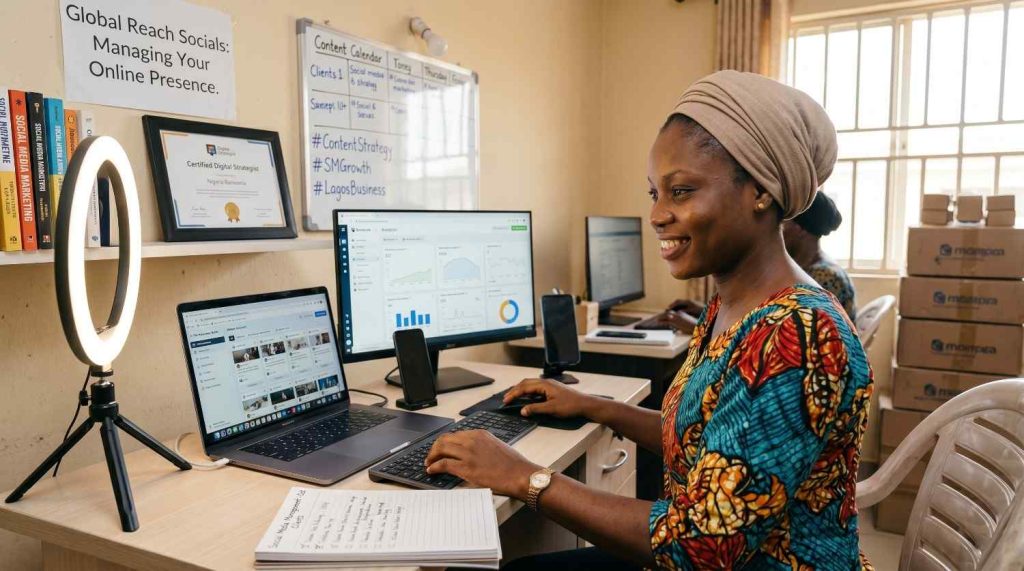
9. Managing Social Media Accounts for Small Businesses
Every small business in Nigeria needs a social media presence. The bakery down your street. The fashion designer in your estate. The real estate agent in your church. The makeup artist your cousin follows on Instagram.
They all know they need to post consistently, engage with followers, and grow their pages. But most of them have no time, no skill, and no interest in doing it themselves.
That’s where you come in.
Social media management is one of the most accessible online gigs for Nigerians because the barrier to entry is remarkably low. If you use Instagram, X, TikTok, or Facebook daily — which you probably do — you already have the foundational knowledge.
What does a social media manager do?
- Create and schedule posts (using tools like Buffer or Later)
- Write captions
- Respond to DMs and comments
- Research trending content ideas
- Run basic paid promotions
- Track engagement metrics
You can start by charging ₦30,000 to ₦50,000 per month per client. Land three clients, and you’re earning ₦90,000 to ₦150,000 monthly. As you gain experience and results, you raise your rates. Experienced social media managers in Nigeria charge ₦100,000 to ₦300,000 per client.
The oversight most newcomers make is trying to manage too many platforms at once for a single client. Start with one or two platforms. Master those. Deliver results. Then expand.
Why is this dirty? Because you’ll spend hours creating content for someone else’s brand, replying to strangers in DMs, dealing with entitled customers who aren’t even yours, and brainstorming captions for a product you don’t personally care about. It’s servant work. But it pays.
Quick Comparison: All 9 Methods at a Glance
| Method | Startup Cost | Skill Level Needed | Monthly Earning Potential (₦) | Best For |
|---|---|---|---|---|
| Transcription | Free | Low | 50,000 – 200,000 | Fast typists |
| Flipping/Reselling | Low (₦5,000+) | Low | 100,000 – 400,000 | Hustlers, traders |
| Boring Content Writing | Free | Medium | 80,000 – 500,000 | Good writers |
| Virtual Assistant | Free | Low-Medium | 150,000 – 800,000 | Organized people |
| Surveys/Micro-tasks | Free | Very Low | 30,000 – 150,000 | Absolute beginners |
| Affiliate Marketing | Low-Medium | Medium-High | 100,000 – 2,000,000+ | Marketers |
| Data Entry | Free | Low | 30,000 – 150,000 | Detail-oriented people |
| Digital Products | Free-Low | Medium | 50,000 – 1,000,000+ | Creative thinkers |
| Social Media Management | Free | Low-Medium | 90,000 – 500,000 | Social media users |
How to Choose the Right Method for You
Don’t try all nine at once. That’s a recipe for burnout and zero results.
Instead, ask yourself three questions:
What do I already know how to do? If you type fast, start with transcription. If you’re always on social media, explore social media management. If you write well, boring content writing is your lane.
How much time do I have? If you’re a student with a few hours daily, surveys and micro-tasks make sense as a starting point. If you have full days available, virtual assistant work or affiliate marketing offers better returns.
How quickly do I need the money? Some methods — like flipping items or data entry — can generate income within days. Others — like digital products and affiliate marketing — take weeks or months to build but offer much higher long-term returns.
Start with one. Get competent. Start earning. Then layer in a second method. This is how people build multiple income streams without losing their minds.
The Mindset Shift You Need
Here’s something that separates people who make money online from those who just talk about it.
The ones making money accepted that the work wouldn’t always be fun. They stopped waiting for the “perfect” opportunity and started with what was available. They treated these “dirty” methods as stepping stones, not final destinations.
The person doing data entry today might be running a digital agency in two years. The person writing boring product descriptions right now might launch their own e-commerce brand next year. The virtual assistant managing someone else’s schedule could be hiring their own VA in 18 months.
Every big thing starts with something small and often unglamorous. The willingness to start small — and stay consistent — is the real competitive advantage.
FAQs
Can I realistically make money online in Nigeria without spending money first?
In reality, yes. Several methods on this list — transcription, virtual assistance, data entry, surveys, and content writing — require nothing more than a phone or laptop and internet access—no upfront investment needed.
Which of these methods pays the fastest?
Selling used items (flipping) and micro-tasks pay the fastest because transactions can happen within hours or days. Content writing and virtual assistant gigs also pay relatively quickly once you land a client.
Do I need a laptop, or can I use my phone?
For some methods, such as surveys, micro-tasks, and social media management, a smartphone is sufficient. However, for transcription, content writing, data entry, and virtual assistant work, a laptop significantly improves your speed and professionalism.
Is affiliate marketing really profitable in Nigeria?
Absolutely. Platforms like Expertnaire have documented cases of Nigerians earning millions through affiliate marketing. The catch is that it requires learning real marketing skills — copywriting, traffic generation, and funnel building. It’s not a “post and pray” game.
How do I receive payments from international clients?
The most common methods for Nigerians are PayPal, Payoneer, Wise (formerly TransferWise), and direct bank transfers through platforms like Upwork that support Nigerian bank accounts. Grey.co and Chipper Cash are also popular options for receiving foreign currency.
Are these methods legal?
Every single method on this list is 100% legal. There is nothing fraudulent, shady, or questionable about any of them. They require real work, real skills, and real effort. The “dirty” label refers only to the unglamorous nature of the work — not its legality.
Can I do more than one of these at the same time?
You can, but don’t start that way. Master one method first. Build consistency and income. Then add a second. Trying to juggle five methods simultaneously as a beginner almost always leads to doing all of them poorly and earning from none.
How long before I start seeing real money?
It depends on the method and your effort. Surveys and flipping can yield income within your first week. Content writing and VA work might take two to four weeks to land your first client. Affiliate marketing and digital products can take one to three months before you see meaningful returns. Patience isn’t optional — it’s required.
Final Word
The internet doesn’t care about your certificate, your state of origin, or your family name. It rewards people who show up, do the work, and solve problems — even small, boring, unglamorous problems.
These nine methods aren’t pretty. They won’t trend on Twitter. Nobody will clap for you at a conference for doing data entry or writing product descriptions for a skincare brand you’ve never used.
But they work.
And in a country where the cost of living climbs every month, and formal employment keeps shrinking, “it works” is the only thing that should matter to you right now.
Pick one. Start today. Get dirty.
Be Earnified!
